Cut bitrate 27% on average.
Up to 71% on the right content.
Quality unchanged.
Kelvin v1.0 is a neural pre-encoder that sits in front of libx264. Same H.264 output, same CDN, smaller files. Validated end-to-end against UVG and MCL-JCV academic reference clips with BD-rate methodology.
Works with your existing infrastructure
Drop into your pipeline.
Optimize everything.
EncodeIQ sits upstream of your CDN as a non-destructive optimization pass. Your delivery infrastructure stays exactly as-is - you just serve smaller files.
Ingest Mezzanines
Connect your S3 bucket or upload masters directly. EncodeIQ validates codec, FourCC, resolution, and pixel format before queuing.
- Amazon S3
- Apple ProRes 422 family (apco, apcs, apcn, apch)
- Raw YUV 4:2:0 8-bit
Kelvin Neural Pre-Encoder
The Kelvin v1.0 model rewrites the master pixels for perceptual efficiency before libx264 sees them. Same H.264 syntax out, smaller files at iso-quality. Three modes for three deployment shapes.
- Mode A: preprocessing only, ship the master
- Mode B: iso-quality VMAF target with matched baseline
- Mode C v2: BD-rate evaluation across a four-point QP grid
Deliver via Your CDN
Optimized files land in your egress S3 bucket. Your CDN, URLs, and playback infrastructure are completely unchanged - only the file size shrinks.
- In-place overwrite or side-by-side output
- Same object keys - zero CDN reconfiguration
- Standard H.264 mp4 outputs (Mode B and Mode C v2)
- Estimated CDN cost reduction dashboard
{
  "input_size_bytes": 5368709120,    // 5.0 GB ProRes HQ
  "output_size_bytes": 3221225472,   // 3.0 GB optimized
  "savings_percent": 40.0,
  "vmaf_score": 96.2,
  "vmaf_source": 98.1,
  "vmaf_delta": -1.9,
  "resolution": "1920x1080",
  "output_codec": "prores_ks HQ",
  "processing_time_seconds": 1245.3
}Everything a professional
video pipeline needs.
BD-Rate Evaluation
Sweep a four-point QP grid {22, 27, 32, 37} on your master and on a libx264 baseline. Compute BD-VMAF, BD-VMAF-NEG, BD-PSNR, and BD-MS-SSIM via PCHIP integration. The deliverable is a rate-distortion curve with iso-quality bitrate savings at any target VMAF, plus a reproducible job summary.
Iso-Quality Compression
Kelvin enhances the master, then a single-pass libx264 RD-search lands within ±0.5 of your target VMAF. A second RD-search on the raw master produces a matched-VMAF baseline. The deliverable is the customer-facing H.264 mp4 plus the matched baseline, so the bitrate delta is a true iso-quality apples-to-apples comparison. Use when you have ground-truth masters and want absolute quality control.
Preprocessing Only
Run Kelvin on the master, write the optimized pixels back. No encode step, no metric computation. Use after Mode C or Mode B has validated the gain on your content. Ship the optimized master to your existing encoder ladder and pick up the savings downstream.
S3-Native Integration
Point EncodeIQ at an ingress bucket prefix. It pulls, processes, and pushes to your origin - all via S3-compatible APIs.
Visual Before/After
Representative frame grabs - source vs. optimized side by side - delivered with every job. Verify quality visually, not just by metrics.
Usage-Based Billing
Pay only for minutes of video processed. Three tiers match your content mix - no contracts, no minimums, no per-seat pricing.
Built for every professional
video workflow.
VOD Libraries
Optimize entire content catalogs stored in S3. Submit a bucket prefix, get back a fully optimized library at the same paths. CDN costs drop immediately.
UGC & Social Platforms
Reduce egress costs at scale. Each uploaded file is independently optimized - parallel Fargate tasks mean thousands of assets processed simultaneously.
Post-Production Houses
Compress ProRes 422 archives without changing the codec family. Store more masters at lower cost; original quality is preserved for future re-encodes via Mode A.
Enterprise OTT
Slot EncodeIQ into your existing Step Functions or media workflow. REST API-first design integrates with any orchestration system via webhook callbacks.
Corporate & Education
Training video, e-learning content, and internal communications - reduce storage and delivery costs without touching your LMS or existing integrations.
SaaS Video Platforms
Offer customers smaller storage footprints and lower CDN bills. EncodeIQ multi-tenant architecture is built for resale - each customer gets isolated projects and billing.
Side-by-side demos.
Real sequences from public benchmark datasets, encoded with Kelvin and with libx264 alone. Watch the difference at near-matching quality.
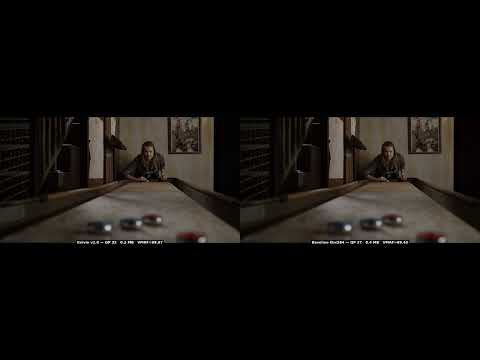
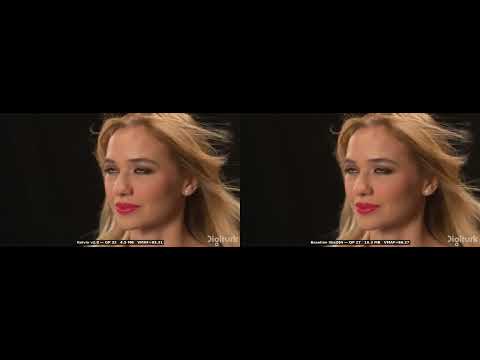
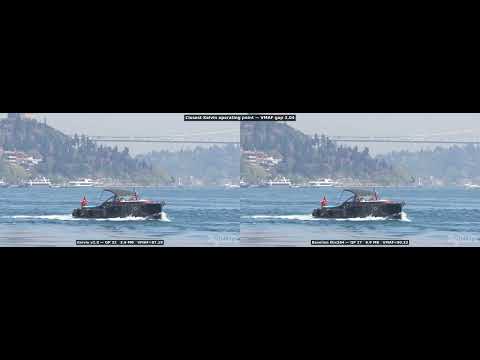
Both clips in each video are decoded H.264. Output is standard H.264 - same decoders, same players, same CDNs.
Simple, usage-based pricing.
Pay per minute of video processed. No monthly minimums, no seat licenses, no surprises. Contact sales for pricing details.
Standard definition - up to 720p resolution
- Up to 1280×720
- ProRes 422 family + raw YUV
- EC2 / A10G GPU / 8 CPUs / 32 GB
- Mode A + Mode C v2
- S3 ingress & egress
High definition - up to 1080p resolution
- Up to 1920×1080
- ProRes 422 family + raw YUV
- EC2 / A10G GPU / 8 CPUs / 32 GB
- Operating-points UI
- Mode A + Mode B + Mode C v2
Ultra high definition - 4K and above
- 4K and above
- ProRes 422 HQ + raw YUV
- EC2 / A10G GPU / 8 CPUs / 32 GB
- Priority processing queue
- Dedicated support SLA
All tiers include: VMAF quality reports, job metrics dashboard, S3 integration, side-by-side quality preview, and Stripe-managed invoicing. Volume discounts available - contact us.
Making Video Optimization
Intelligent, Measurable, and Effortless
Our Mission
As video consumption explodes and delivery costs scale with every stream, organizations face an urgent challenge - reducing bandwidth spend without sacrificing the viewing experience their audiences expect.
EncodeIQ makes this possible. We bring neural-network perceptual optimization to professional video pipelines, revealing exactly how much bitrate can be removed while maintaining studio-grade quality - measured, guaranteed, and auditable.
The EncodeIQ Difference: Conventional encoders work on the input as given. Kelvin v1.0 is a neural pre-encoder that rewrites the master pixels for perceptual efficiency before libx264 sees them. The result is the same H.264 bitstream syntax with smaller files at iso-quality, validated curve-by-curve against academic reference clips. Verify it yourself: the full H.264 rate-distortion benchmark for Kelvin v1.0 - configs, encoded bitstreams, per-QP CSVs, and BD-rate scripts - is open and reproducible at github.com/marcoeg/kelvin-benchmark. Read the technical paper on arXiv: arXiv:2605.16376.
Graziano Labs Corp.
Palo Alto, CaliforniaA California corporation building AI-powered optimization tools for professional video infrastructure. Graziano Labs sits at the intersection of machine learning, video engineering, cloud architecture, and content delivery economics.
Marco Graziano
Founder & CEOMarco brings extensive experience in product leadership and technical architecture across consumer electronics, video streaming systems, and enterprise-grade cloud software. His deep expertise in video compression, broadcast standards (DVB-T, SDI, ST 2110, IPTV), and CDN delivery economics drives EncodeIQ's technical vision.
With a proven track record building products at the intersection of video, cloud, and AI - Marco leads Graziano Labs' mission to make professional video optimization as simple as pointing at an S3 bucket.
Frequently asked questions.
What formats does EncodeIQ support?
EncodeIQ v1.0 accepts raw YUV (4:2:0, 8-bit) and the Apple ProRes 422 family (Proxy, LT, 422, 422 HQ; FourCCs apco, apcs, apcn, apch). ProRes 4444, 4444 XQ, and 4444 RAW HQ are rejected at submit. Mode A outputs preprocessed pixels in the same family as the input. Mode B and Mode C v2 output standard H.264 mp4s.
Does EncodeIQ change my CDN configuration?
No. EncodeIQ writes optimized files back to S3 paths you control. Mode A preserves the input format for downstream encoder compatibility; Mode B and Mode C v2 produce standard H.264 mp4s. Your CDN, player, and delivery infrastructure require zero changes.
How is quality measured and reported?
EncodeIQ reports BD-rate against your master rather than enforcing a single VMAF floor. Mode C v2 sweeps a four-point QP grid {22, 27, 32, 37} on the Kelvin output and on a libx264 baseline, then computes BD-VMAF, BD-VMAF-NEG, BD-PSNR, and BD-MS-SSIM via PCHIP integration (bjontegaard 1.3.0). The deliverable is the full rate-distortion curve plus iso-quality bitrate savings at any target VMAF you choose. Mode B uses a single-pass libx264 RD-search to land within ±0.5 of a target VMAF and ships a matched-VMAF baseline so the bitrate delta is a true apples-to-apples comparison.
What is BD-rate, and why use it?
BD-rate (Bjøntegaard delta rate) is the standard codec-comparison metric in the video research literature. It integrates the difference between two rate-distortion curves to produce a single number: the average percentage bitrate change at iso-quality across the operating range. Negative BD-VMAF means our pre-encoder produces the same perceptual quality at lower bitrate. We report BD-rate because customers can verify it independently with public tooling, and because it captures curve shape rather than a single operating point. Read the methodology in the technical report linked in Resources.
How do you prove the savings number?
Every Mode C v2 job produces a signed summary.json containing the checkpoint SHA-256, the worker container image digest, ffmpeg and libvmaf versions, full RD points at every QP, and start and finish timestamps. The libx264 baseline mp4s are bit-exact deterministic (verified by sha256). BD-VMAF reproduces to three decimals across cloud runs at the same checkpoint. Anyone with the master can re-run the methodology and arrive at the same number.
How does billing work?
Billing is per minute of video processed, metered at SD, HD, and 4K+ resolution tiers. Usage is aggregated monthly and billed via Stripe. You receive an itemized invoice per project showing minutes processed by resolution tier and total cost. No minimums or commitments.
Can I run EncodeIQ on my own AWS account?
EncodeIQ is a hosted service - we run the Fargate processing infrastructure so you don't have to. Your S3 buckets remain in your own AWS account; EncodeIQ accesses them via cross-account IAM roles that you provision and control. A self-hosted option for enterprise customers is on the roadmap.
Methodology, in depth.
Read how Kelvin v1.0 works, what BD-rate methodology we run, and how we validated the published numbers.
Inside Kelvin v1.0 - A Neural Pre-Encoder for H.264
A technical report on the neural pre-encoder for H.264 shipping inside cloud service EncodeIQ. Covers architecture, training, evaluation methodology (BD-rate via PCHIP, libvmaf two-call, four-point QP grid), full UVG and MCL-JCV sweep results, failure-mode taxonomy, cost per encoded hour, and the parity harness that gates every release. By Marco Graziano, Graziano Labs Corp.
Start optimizing your
video library today.
Join the early access program. We onboard teams individually - connect your S3 bucket, run a test batch, and see the savings in your first session.
No credit card required for the free trial. 30-day free access to HD tier (up to 30 minutes of video).